.png)


.png)
The Green Profit: ROI of Sustainable Real Estate in Bali

For years, the conversation around sustainability in real estate was driven by moral imperative the idea that we "should" build green to save the planet. While that remains true, the narrative in the high-end Bali market of 2025 has shifted dramatically toward financial intelligence. Today, sustainability is no longer just an ethical choice; it is a sophisticated investment strategy designed to lower operational overheads, increase asset value, and capture the most lucrative segment of the tourism market.
At JK Global Properties, we view "green" features not as expenses, but as high-yield upgrades. In a tropical climate where electricity and water are variable costs, a villa engineered for efficiency outperforms a standard build on the balance sheet. By integrating solar technology, water autonomy, and passive cooling design, investors can secure a "Green Premium" a measurable increase in Net ROI that compounds over the lifespan of the leasehold. This article explores the financial mechanics of sustainable real estate investment in Bali, proving that the smartest money is also the cleanest.
The Solar Calculus: CapEx vs. OpEx
The most visible component of a sustainable strategy is solar energy. Historically, investors hesitated due to the upfront Capital Expenditure (CapEx). However, as electricity tariffs from the state provider (PLN) fluctuate and consumption in luxury villas rises (due to air conditioning demands), the math has tipped in favor of solar.
The Payback Period
Implementing a full solar array with battery storage for a luxury villa typically requires an initial investment of USD 30,000 to USD 50,000. While this adds to the initial build cost, the reduction in monthly electricity bills is drastic. In a sunny climate like Bali, a well-calibrated system can power the villa during the day and run essential systems at night.
- The Breakeven: Data indicates that the typical payback period for this expense is 5 to 7 years.
- The Profit Phase: In a 25 or 30-year leasehold, this means that after year 7, the system is essentially generating "free" energy. For the remaining 18+ years of the lease, the money that would have gone to PLN stays in your Net Profit column. This operational saving directly boosts the annual yield.
Energy Security
Beyond pure cost savings, solar provides energy security. Bali can experience power fluctuations. A villa equipped with solar and battery backup offers guests an uninterrupted experience, ensuring that the WiFi and AC keep running during a localized blackout. This reliability is a key selling point that prevents refunds and bad reviews.
Water Independence in the Limestone Hills
Water is arguably the most critical resource in Bali, particularly in the high-investment corridors of the Bukit Peninsula (Uluwatu, Pecatu, Bingin). This region sits on a dry limestone plateau where municipal water (PDAM) can be inconsistent.
Mitigating Scarcity with Engineering
For investors in the Bukit, water scarcity is an operational challenge that must be engineered away. Relying solely on water trucks is expensive and logistically fragile.
- Rainwater Harvesting: A sustainable real estate investment in Bali incorporates large-scale underground cisterns to harvest rainwater during the monsoon season. This "free" water reduces the reliance on purchased trucked water.
- The Bukit Strategy: In these dry limestone topographies, water storage tanks and harvesting systems are not optional; they are essential for mitigating operational risks and ensuring reliability. A villa that never runs out of water commands higher occupancy and guest trust than one known for dry taps.
Recycling for ROI
Advanced systems also treat "greywater" (from showers and sinks) to irrigate the lush tropical gardens that define Bali villas. By recycling water for landscaping, you reduce the consumption of clean water, further lowering the monthly utility bill and protecting the local aquifer.
The Marketing Edge: Attracting the "Conscious Traveler"
The demographic profile of the Bali visitor is evolving. We are seeing a surge in "Conscious Travelers" high-net-worth individuals who align their spending with their values. They actively seek out eco-friendly accommodation and are willing to pay a premium for it.
The Zero-Waste Premium
Implementing zero-waste practices does more than just lower utility costs; it serves as a powerful marketing tool.
- Reputation Management: Villas that eliminate single-use plastics, provide filtered water stations (reducing plastic bottles), and compost organic waste improve their sustainability credentials.
- ROI Impact: These practices attract eco-conscious guests who tend to stay longer and treat the property with greater respect. This "Green Premium" can enhance long-term ROI beyond immediate cost savings by differentiating your property in a crowded market. In a sea of concrete villas, the "eco-luxury" label is a unique selling proposition (USP) that justifies a higher nightly rate.
Passive Design: Cooling Without the Cost
Sustainability starts with architecture. A truly efficient villa is designed to keep itself cool, reducing the load on mechanical air conditioning. This is known as Passive Cooling.
Functional Durability and Design
At JK Global Properties, we emphasize the use of materials that work with the climate, not against it.
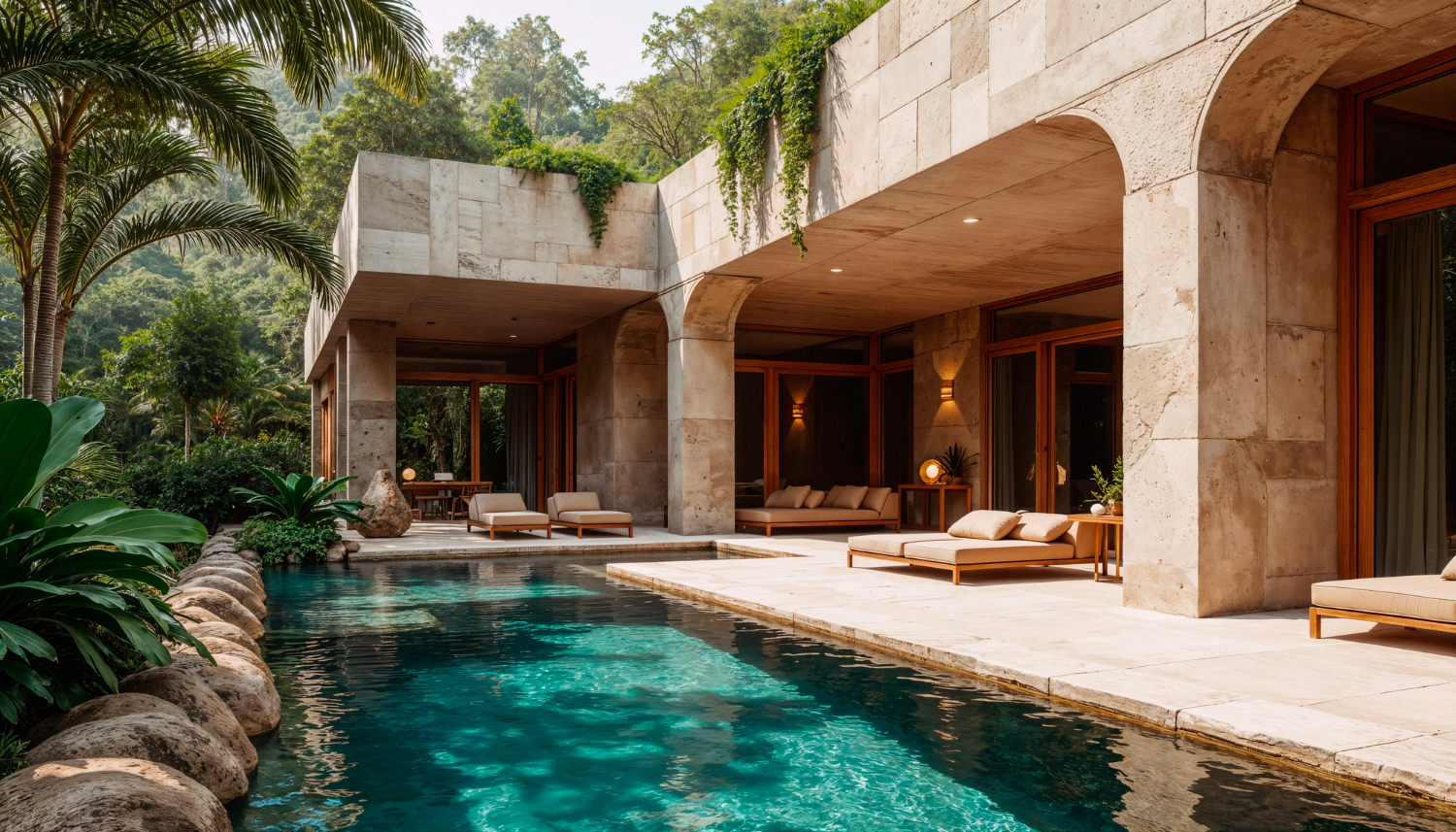
- Thermal Regulation: The use of natural stone and high-quality treated teak wood helps regulate internal temperatures. Stone walls have high thermal mass, absorbing heat during the day and releasing it at night.
- Airflow Engineering: Intelligent design utilizes cross-ventilation and deep roof overhangs to shade glass facades from direct sun. By lowering the ambient temperature of the living spaces naturally, the AC units work less hard. This extends the lifespan of the equipment and, again, slashes the electricity bill the largest line item in any villa's Operational Expenses (OpEx).
Durability as Sustainability
Building with durable materials is the ultimate form of sustainability. Replacing a rotted timber deck every three years is expensive and wasteful. By using materials resistant to humidity and salinity , you reduce the "churn" of renovation, maintaining your Net Profit by reducing maintenance expenses over time.
Operational Efficiency: The Path to Higher Net Yields
Ultimately, the goal of any investment is to maximize the spread between Gross Revenue and Net Profit. Sustainable features are the most effective tool for widening this spread.
Minimizing OpEx
Your Annual Total Costs are heavily weighted by utilities and maintenance. Management strategies that prioritize energy efficiency and streamlined operations directly minimize these costs.
- The Calculation: If two villas generate $100,000 in Gross Revenue, but the "Sustainable Villa" spends $10,000 less per year on electricity and water due to solar and recycling systems, that $10,000 flows directly to the investor. Over a 10-year period, that is $100,000 in additional profit generated purely by efficiency.
- Resilience: Lower overheads make the investment more resilient during low seasons. When occupancy drops, a sustainable villa with low running costs "bleeds" less cash than a standard villa with high fixed utility demands.
Future-Proofing Your Asset
Real estate is a long game. The standards of 2026 will be obsolete by 2035. However, the trajectory of global regulation and consumer preference is clearly moving toward sustainability.
Regulatory Anticipation
Governments worldwide, including Indonesia, are gradually tightening building codes regarding energy efficiency and water use. By investing in these standards now voluntarily you future-proof your asset against upcoming regulations that might force costly retrofits on older, inefficient buildings.
Resale Value
When it comes time to exit the investment, a villa with a verified "green" track record, lower operating costs, and modern energy infrastructure will command a higher resale price. Future buyers will scrutinize utility bills just as closely as the view. A property that is cheap to run is easier to sell.
The Smart Money Goes Green
The sustainable real estate investment in Bali is no longer an alternative niche; it is the benchmark for modern luxury. It represents a convergence of ethical responsibility and financial acuity.
At JK Global Properties, we guide our investors to look past the initial price tag of solar panels or water systems and see the long-term financial architecture. We understand that a payback period of 5-7 years is a blip in the lifespan of a profitable leasehold. By engineering villas that harvest their own resources and market themselves to the highest quality guests, we turn sustainability into a powerful engine for wealth creation. In Bali, green is not just the color of the jungle; it is the color of your optimized portfolio.